About ten years ago, when I was living in Santa Fe, New Mexico, I happened one day to be browsing in a little bookshop (called The Noble Truth Bookstore) next to the Bodhi Stupa – both a part of the KSK Dharma Center.
My glance fell onto one particular book, whose cover featured a most captivating photo: a young boy in crimson and ochre robes, wearing a black crown with a golden diamond emblem, through whose eyes flowed a kind of power and clarity that caused me immediately to fall in love and awe with this unknown being.
The young boy was, I learned, the 8-year-old Karmapa – and the book, a rendering by Ken Holmes of his most amazing existence. I immersed myself in the book, and its wonderful photos – drawn back to it, almost magnetically, again and again. I knew that some day, somehow, I would meet this person – I simply had to!
When I learned that HH Karmapa was planning a visit to the very city in which I now lived, it felt like a miracle. My heart overflowed with excitement, joy and gratitude. I returned to the book, as food for an already blossoming inspiration.
Two weeks before His Holiness was to arrive in Boulder, he appeared in my dream, first as a red-headed and rather clumsy Caucasian man (which of course surprised me a bit), then later materialized – seemingly out of thin air – on the stage of the auditorium, and proceeded to offer his first Dharma talk, on the topic of “not being fooled by appearances.”
The night before His Holiness actually arrived in Boulder, I had another dream/vision, in which Karmapa had become inseparable from the Boulder Mountains and – as the mountains – was literally embracing the city with his extended arms. Then – twice – the image of rain – an intense downpour – a “rain of blessings.”
Then he was actually here, which was wonderful in countless ways. And then, for two days following his departure: intense rainfall here in Boulder – as though a parting gift of a dream become reality.
Now the memory – like a medicine more potent than any imagined – continues to nourish me, even as I write this account of nested dreams, and the precious opportunity to find myself at the feet, held within the Radiance, of a living Buddha: a new and longtime friend …
Friday, June 13, 2008
A New and Longtime Friend
Elizabeth R. from Boulder, Colorado wrote to share this personal story of connection to His Holiness Karmapa and his first visit to America:

Wednesday, June 11, 2008
Your Story
How were you affected by His Holiness Karmapa's first visit to the U.S.? What did it mean to you? Do you have an interesting story to share about the visit?
Readers of the blog are invited to submit their own thoughts (200 words or less) for possible inclusion here.
(Please note that not all submissions will necessarily be published, and published submissions may be edited.)
Email to karmapa(dot)foundation(at)gmail(dot)com.
Readers of the blog are invited to submit their own thoughts (200 words or less) for possible inclusion here.
(Please note that not all submissions will necessarily be published, and published submissions may be edited.)
Email to karmapa(dot)foundation(at)gmail(dot)com.
Monday, June 9, 2008
Commemorative Merchandise and Recordings
Commemorative items and souvenirs that were available at the public teachings in New York, Boulder and Seattle may now be purchased online through Karmapa Foundation's merchandising partnership with Ziji. Items include T-shirts, caps, posters, tote bags, pendants, shrine photos, and a Lion's Roar CD set, along with a special commemorative issue of Bodhi magazine featuring teachings by Karmapa.


Click here to visit Ziji's official Karmapa In America '08 merchandise page. Proceeds support Karmapa Foundation.
Many people have also been inquiring about recordings of the Karmapa's U.S. teachings and whether they will be made available at some point. The answer is yes (!) but not just yet. Post-production (editing, reproduction onto CD/DVD, etc.) will take time. Information about recordings will be posted here when it becomes available, and at the web site, karmapavisit.org. Stay tuned over the coming weeks.
Saturday, June 7, 2008
His Holiness Returns Safely to India
With thousands of American hearts blooming with love and devotion from his visit, His Holiness the 17th Gyalwang Karmapa has returned safely to India and has resumed his residency at Gyuto Tantric University in Sidhbhari, near Dharamsala, India. Kagyu Office, His Holiness's official website, has posted journal entries detailing information about His Holiness's arrival at Delhi International Airport, where he was greeted by throngs of dignitaries and supporters; a welcome dinner held in his honor at Delhi's Airport Radisson Hotel; and an elaborate ceremonial reception hosted by the Karmapa's Office of Administration and the leaders of Gyuto Tantric University at His Holiness's temporary residence at Gyuto. Please go the Kagyu Office website for full details.
During his visit to the United States, His Holiness, on more than one occasion, commented about his plans to remember again and again what it was like to spend time together with his American friends once he returned to India, even saying at one point (with a buoyant smile) that he would "visualize" each and every one of the friends he had met and seen. With great delight in the news of his safe and comfortable return, there is no doubt that we, His Holiness's American students and friends, will be recalling, again and again, in our hearts and minds the wonderful experiences of being the recipients of His Holiness's unfathomable generosity, wisdom, and warmth, and offering these feelings of gratitude as flowers thrown skyward in supplication for his swift return and the fulfillment of all his wishes.
During his visit to the United States, His Holiness, on more than one occasion, commented about his plans to remember again and again what it was like to spend time together with his American friends once he returned to India, even saying at one point (with a buoyant smile) that he would "visualize" each and every one of the friends he had met and seen. With great delight in the news of his safe and comfortable return, there is no doubt that we, His Holiness's American students and friends, will be recalling, again and again, in our hearts and minds the wonderful experiences of being the recipients of His Holiness's unfathomable generosity, wisdom, and warmth, and offering these feelings of gratitude as flowers thrown skyward in supplication for his swift return and the fulfillment of all his wishes.
Thursday, June 5, 2008
Wednesday, June 4, 2008
TIME

Pick up a copy of the new issue (dated June 9, 2008 - cover shown above) of TIME magazine, hitting newsstands now across the nation, for a profile of His Holiness Karmapa by senior writer David van Biema. The story includes a stunning full-page portrait of His Holiness taken by photographer Lynn Goldsmith while the Karmapa was in New York City.

His Holiness the 17th Karmapa in New York City,
May 18, 2008. Copyright 2008 Lynn Goldsmith.
The Sky Dragon's Profound Roar
Organizers of the Karmapa In America '08 tour received word yesterday that His Holiness Karmapa landed safely in Delhi, India. Dekila Chungyalpa captured this beautiful image of His Holiness aboard an airplane en route to Newark International Airport from Seattle (click on photo to enlarge):

His Holiness Karmapa en route from Seattle
to Newark, June 2, 2008. Photographer:
Dekila Chungyalpa. Copyright 2008 by Karmapa
Foundation.

His Holiness Karmapa en route from Seattle
to Newark, June 2, 2008. Photographer:
Dekila Chungyalpa. Copyright 2008 by Karmapa
Foundation.
Up in the sky's expanse, true being, unborn, forever pureBlog reader Luyen posted this comment that summarizes the feelings and aspirations of so many whose lives were deeply touched and transformed by the Karmapa's first visit to America:
Beautiful is the world below me—how many colors do I see?
But when I look, I can't find anything that's born or has a root
So the time has come to meditate on true reality, of ego-clinging free.
-- Khenpo Tsultrim Gyamtso Rinpoche, "The Sky Dragon's Profound Roar"
So rare a thing it is to have a being dedicated solely to the happiness of others, touch the hearts of so many in such a profound way...
Your teachings were profound and your aspirations long lasting, I pray that you will return soon, as it's clear that everyone will benefit.
Monday, June 2, 2008
Fortune Cookie
His Holiness Karmapa departed Seattle this morning for his return trip to India, bringing a close to his very successful and inspirational first visit to America. At a private farewell ceremony last night at Nalanda West in Seattle, His Holiness thanked the organizers and sponsors of the visit as well as the governments of India, Tibet and the United States for all their encouragement and support in making the visit possible.
Before coming to the farewell ceremony, His Holiness said, he had dinner at a Chinese restaurant. At the conclusion of the meal, a plate of fortune cookies was brought to the table. As His Holiness reached for one of the fortune cookies, he says, he formed the intention that the message inside the cookie should be something connected to his next visit to America.
At the farewell ceremony, His Holiness had his translator read the message from the fortune cookie aloud to the students and supporters present. The fortune cookie stated:
YOU WILL VISIT A FARAWAY LAND THAT HAS BEEN IN YOUR THOUGHTS.
Before coming to the farewell ceremony, His Holiness said, he had dinner at a Chinese restaurant. At the conclusion of the meal, a plate of fortune cookies was brought to the table. As His Holiness reached for one of the fortune cookies, he says, he formed the intention that the message inside the cookie should be something connected to his next visit to America.
At the farewell ceremony, His Holiness had his translator read the message from the fortune cookie aloud to the students and supporters present. The fortune cookie stated:
YOU WILL VISIT A FARAWAY LAND THAT HAS BEEN IN YOUR THOUGHTS.
Karmapa's Aspiration for the World
Yesterday morning His Holiness Karmapa gave the Avalokiteshvara Empowerment to a sold-out house of 2,800 at Seattle's Paramount Theatre, and in the afternoon taught on his song "Aspiration for the World." Because we need to depend on things and people other than ourselves for every benefit that we experience in life, Karmapa taught, our happiness is therefore connected to other beings and their well-being. However, our habitual "me and mine" mentality of self-centricity does not bring us happiness -- rather, the source of happiness lies in working for the benefit of others, since our own happiness cannot come from anywhere else.
His Holiness Karmapa shared many personal stories from his own life to illustrate his teachings. Although the Gyalwang Karmapa is regarded by some as being a fully enlightened and faultless Buddha, nevertheless this has not prevented the Karmapa from experiencing hardship in life. The key, Karmapa said, is how we meet the hardships we encounter -- we can embrace hardships as opportunities to grow and think in different ways and create more benefit for ourselves and others. But often, we simply create a lot of negative "self-talk" about our situation that compounds more suffering onto the original hardship. We can learn to allow hardships to happen (since we cannot, in many cases, prevent them) but limit the self-talk about them.
Our minds, Karmapa said, often become like a motor that is always running at high speed -- but it does not always need to be running at high speed. Sometimes we need to shut down the motor and simply relax.
In the West we have experienced so many external advancements and technological benefits, yet we have also seen a corresponding increase of fear and suffering in people's minds, His Holiness said. This is related to our inability to cherish others -- our pattern of clinging solely to our own concerns, the habitual "me and mine" mentality. If we are not aware of how our happiness depends upon others and we do not work to benefit others, we end up with a society full of people who think only about themselves and act in ways that cause harm to themselves and those around them.
His Holiness expressed his profound gratitude to everyone who has helped make his first visit to America possible, and said that he has been very happy during his stay here -- and said he didn't quite realize this until someone showed him some of the photographs from his travels here, and he saw that he was smiling in many of the pictures. The Karmapa said that this surprised him somewhat, as he does not generally smile a great deal. His Holiness said that his happiness during his travels in America came from the fact that everyone around him was also happy and smiling -- a further illustration of his teaching that our happiness depends upon others.

Paramount Theatre before His Holiness Karmapa's teaching, May 31, 2008.
Photographer: James Gritz. Copyright 2008 by Karmapa Foundation.

Dzogchen Ponlop Rinpoche delivers opening
remarks before His Holiness Karmapa's teaching
at Paramount Theatre in Seattle, May 31, 2008.
Photographer: James Gritz. Copyright 2008 by
Karmapa Foundation.
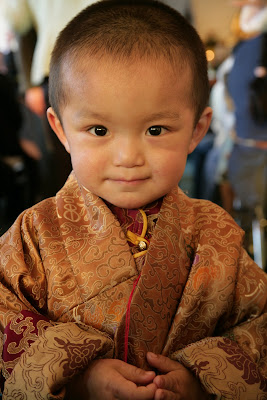
A young Tibetan audience member waiting to see
His Holiness Karmapa. May 30th, 2008.
Photographer: James Gritz. Copyright 2008 by
Karmapa Foundation.
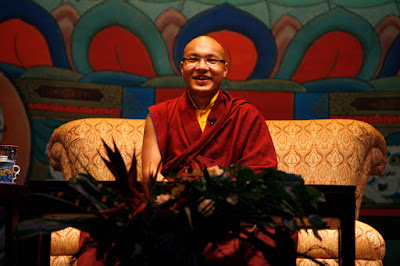
His Holiness Karmapa teaching at Paramount Theatre in Seattle, May 31,
2008. Photographer: James Gritz. Copyright 2008 by Karmapa Foundation.
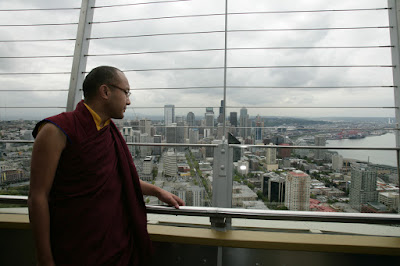
His Holiness Karmapa at Seattle's Space Needle, May 30, 2008.
Photographer: James Gritz. Copyright 2008 by Karmapa Foundation.

His Holiness Karmapa enjoys a Seattle boat ride. May 30th, 2008.
Photographer: James Gritz. Copyright 2008 by Karmapa Foundation.
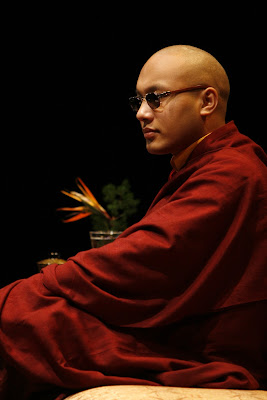
His Holiness Karmapa teaching at Paramount
Theatre in Seattle, May 31, 2008. Photographer:
James Gritz. Copyright 2008 by Karmapa Foundation.
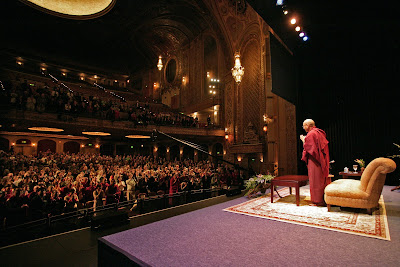
His Holiness Karmapa addresses members of the West coast organizing
sanghas for the U.S. visit at Seattle's Paramount Theatre, May 31, 2008.
Photographer: James Gritz. Copyright 2008 by Karmapa Foundation.
His Holiness Karmapa shared many personal stories from his own life to illustrate his teachings. Although the Gyalwang Karmapa is regarded by some as being a fully enlightened and faultless Buddha, nevertheless this has not prevented the Karmapa from experiencing hardship in life. The key, Karmapa said, is how we meet the hardships we encounter -- we can embrace hardships as opportunities to grow and think in different ways and create more benefit for ourselves and others. But often, we simply create a lot of negative "self-talk" about our situation that compounds more suffering onto the original hardship. We can learn to allow hardships to happen (since we cannot, in many cases, prevent them) but limit the self-talk about them.
Our minds, Karmapa said, often become like a motor that is always running at high speed -- but it does not always need to be running at high speed. Sometimes we need to shut down the motor and simply relax.
In the West we have experienced so many external advancements and technological benefits, yet we have also seen a corresponding increase of fear and suffering in people's minds, His Holiness said. This is related to our inability to cherish others -- our pattern of clinging solely to our own concerns, the habitual "me and mine" mentality. If we are not aware of how our happiness depends upon others and we do not work to benefit others, we end up with a society full of people who think only about themselves and act in ways that cause harm to themselves and those around them.
His Holiness expressed his profound gratitude to everyone who has helped make his first visit to America possible, and said that he has been very happy during his stay here -- and said he didn't quite realize this until someone showed him some of the photographs from his travels here, and he saw that he was smiling in many of the pictures. The Karmapa said that this surprised him somewhat, as he does not generally smile a great deal. His Holiness said that his happiness during his travels in America came from the fact that everyone around him was also happy and smiling -- a further illustration of his teaching that our happiness depends upon others.
Paramount Theatre before His Holiness Karmapa's teaching, May 31, 2008.
Photographer: James Gritz. Copyright 2008 by Karmapa Foundation.

Dzogchen Ponlop Rinpoche delivers opening
remarks before His Holiness Karmapa's teaching
at Paramount Theatre in Seattle, May 31, 2008.
Photographer: James Gritz. Copyright 2008 by
Karmapa Foundation.
A young Tibetan audience member waiting to see
His Holiness Karmapa. May 30th, 2008.
Photographer: James Gritz. Copyright 2008 by
Karmapa Foundation.
His Holiness Karmapa teaching at Paramount Theatre in Seattle, May 31,
2008. Photographer: James Gritz. Copyright 2008 by Karmapa Foundation.
His Holiness Karmapa at Seattle's Space Needle, May 30, 2008.
Photographer: James Gritz. Copyright 2008 by Karmapa Foundation.

His Holiness Karmapa enjoys a Seattle boat ride. May 30th, 2008.
Photographer: James Gritz. Copyright 2008 by Karmapa Foundation.
His Holiness Karmapa teaching at Paramount
Theatre in Seattle, May 31, 2008. Photographer:
James Gritz. Copyright 2008 by Karmapa Foundation.
His Holiness Karmapa addresses members of the West coast organizing
sanghas for the U.S. visit at Seattle's Paramount Theatre, May 31, 2008.
Photographer: James Gritz. Copyright 2008 by Karmapa Foundation.
Sunday, June 1, 2008
Karmapa on Building a Strong Foundation for Spiritual Practice
Yesterday His Holiness the 17th Karmapa gave his first public teachings on the West coast of the United States, to a crowd of nearly 2,800 at Seattle's beautiful Paramount Theatre. His Holiness taught on a special text he had composed on the preliminary practices (ngondro), which help lay the foundation for a strong spiritual practice by turning the mind towards the Dharma.
His Holiness also spoke of how the world we live in is getting smaller and smaller due to technology and globalization, and people's individual actions therefore have a much greater effect on the global village and the whole of humanity. This era, His Holiness said, is no longer one in which people can afford to cling to their particular views or self-centric identities -- not even the limited notion of "being a Buddhist." We need to think in larger terms.
Karmapa spoke of the preliminary practices as being akin to learning the alphabet and reading/writing -- common forms of learning that lay the foundation for more uncommon or advanced forms of learning that come later in one's educational process. Without the basic knowledge established by the common forms of learning, one could not cultivate a genuine knowledge of a higher order. Continuing this parallel between our spiritual education and our secular education, His Holiness said that we should, in the beginning, approach our spiritual education in the same manner: as a straightforward, simple process of education in which we engage so that we can gradually develop greater knowledge and confidence.
In the evening, His Holiness Karmapa gave a teaching to an assembled audience of members of the sanghas who organized his first visit to the West coast of America. His Holiness answered four questions that had been preselected. One question concerned which Dharma practices and study topics are most important in this age. His Holiness said that due to technology and external advancements, we have obtained the power to cause a lot of changes in the world, but for a long time we were not mindful about how we used this power. Now people are becoming more mindful, but so much damage has already been done, and we are on the verge of destroying our planet and our own ability to live here. In this day and age, His Holiness said, the practitioner's motivation to attain one's own personal liberation is "no longer sufficient whatsoever" -- instead, we need practitioners who can benefit the whole world while also engaging in their own personal practice. The old model of a yogi going off into isolation for many years and then working in a limited way with only a handful of students is no longer particularly practical or helpful -- rather, we need practitioners who are out in the world working for the benefit of the world.
Another question concerned how Western students, with limited time and resources to practice, might establish the genuine Buddhist lineage in our home lands. His Holiness spoke about the need for continuity of practice, which requires firm resolve. We need to remind ourselves again and again of what it is that we wish to accomplish through our practice and refresh that resolve every day to keep the momentum of our practice going. This resolve, the Karmapa said, cannot be a mere thought in our heads, but must be a strong building up of energy and intention within ourselves. His Holiness suggested that we could work with setting one clear goal and working with that goal for an entire month, reminding ourselves of it each day.
Most of us, His Holiness said, are not lacking in pith instructions from our gurus and teachers -- the problem, rather, is that we lack pith instructions from ourselves. We need to learn how to look within, listen to ourselves, and seek out instructions from our own minds.
His Holiness also spoke of how the world we live in is getting smaller and smaller due to technology and globalization, and people's individual actions therefore have a much greater effect on the global village and the whole of humanity. This era, His Holiness said, is no longer one in which people can afford to cling to their particular views or self-centric identities -- not even the limited notion of "being a Buddhist." We need to think in larger terms.
Karmapa spoke of the preliminary practices as being akin to learning the alphabet and reading/writing -- common forms of learning that lay the foundation for more uncommon or advanced forms of learning that come later in one's educational process. Without the basic knowledge established by the common forms of learning, one could not cultivate a genuine knowledge of a higher order. Continuing this parallel between our spiritual education and our secular education, His Holiness said that we should, in the beginning, approach our spiritual education in the same manner: as a straightforward, simple process of education in which we engage so that we can gradually develop greater knowledge and confidence.
In the evening, His Holiness Karmapa gave a teaching to an assembled audience of members of the sanghas who organized his first visit to the West coast of America. His Holiness answered four questions that had been preselected. One question concerned which Dharma practices and study topics are most important in this age. His Holiness said that due to technology and external advancements, we have obtained the power to cause a lot of changes in the world, but for a long time we were not mindful about how we used this power. Now people are becoming more mindful, but so much damage has already been done, and we are on the verge of destroying our planet and our own ability to live here. In this day and age, His Holiness said, the practitioner's motivation to attain one's own personal liberation is "no longer sufficient whatsoever" -- instead, we need practitioners who can benefit the whole world while also engaging in their own personal practice. The old model of a yogi going off into isolation for many years and then working in a limited way with only a handful of students is no longer particularly practical or helpful -- rather, we need practitioners who are out in the world working for the benefit of the world.
Another question concerned how Western students, with limited time and resources to practice, might establish the genuine Buddhist lineage in our home lands. His Holiness spoke about the need for continuity of practice, which requires firm resolve. We need to remind ourselves again and again of what it is that we wish to accomplish through our practice and refresh that resolve every day to keep the momentum of our practice going. This resolve, the Karmapa said, cannot be a mere thought in our heads, but must be a strong building up of energy and intention within ourselves. His Holiness suggested that we could work with setting one clear goal and working with that goal for an entire month, reminding ourselves of it each day.
Most of us, His Holiness said, are not lacking in pith instructions from our gurus and teachers -- the problem, rather, is that we lack pith instructions from ourselves. We need to learn how to look within, listen to ourselves, and seek out instructions from our own minds.
Subscribe to:
Posts (Atom)
